
Losing a tooth creates an immediate dilemma between replacing it with a traditional bridge or anchoring a permanent artificial root. Navigating bone health, treatment timelines, and overall surgical costs often leaves patients unsure of their best option.
Single-tooth dental implants in Richmond Hill provide a permanent replacement by anchoring a titanium post into the jawbone, fusing over a three to six-month healing period. The total cost typically ranges from C$3,000 to C$5,000, covering surgical placement and a custom ceramic crown.
Understanding structural bone requirements, sedation options, and daily hygiene practices allows you to evaluate your candidacy and select a long-term restorative treatment plan with confidence.
Successful treatment requires a minimum horizontal bone width of 6 millimetres and stable periodontal health with site bleeding on probing under 10 percent before surgical placement begins.
What is a single-tooth dental implant and how does it work?
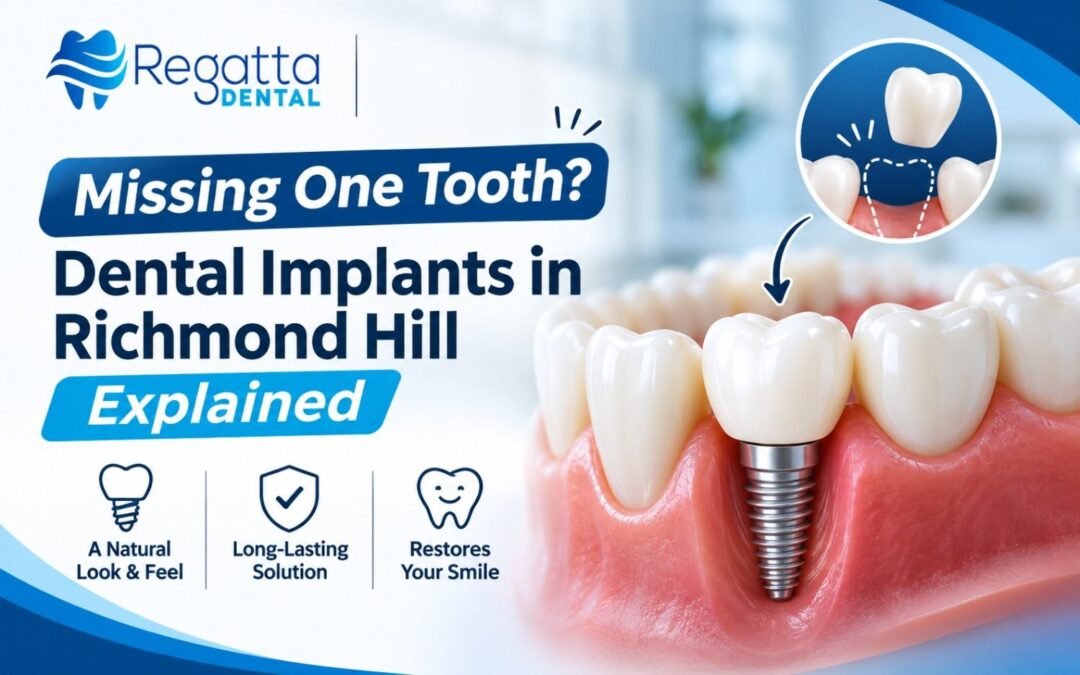
A single-tooth dental implant serves as an artificial tooth root replacement, surgically anchored into the jawbone to restore a missing tooth. In restorative dentistry, your Richmond Hill dentist uses a titanium post that fuses with surrounding bone tissue through osseointegration over several months. This post creates a rigid foundation for a custom-crafted dental crown tailored to match adjacent natural teeth.
Structural components of a single implant
A complete single implant assembly consists of three distinct parts designed to replace missing teeth permanently. Your clinician begins with titanium implant fixture selection, choosing a post diameter between 3.5 mm and 6.0 mm based on available bone width. This titanium post serves as the structural foundation within the jaw.
After initial healing, a custom abutment connection mechanism joins the fixture to the visible tooth replacement. Lab technicians then complete the restorative dental crown fabrication using durable ceramic or porcelain. This top portion matches the exact shade and contour of existing natural teeth.
Treatment costs for a single tooth replacement in Ontario typically range from $3,000 to $5,000 CAD per tooth. Total investment depends on whether you require preliminary bone grafting or special options like sedation dentistry. A Richmond Hill dentist determines your candidacy by evaluating 3D cone-beam X-ray scans during an initial assessment.
Biological integration through osseointegration
Osseointegration is the direct structural connection between living bone cells and the surface of a titanium post. Primary structural stability factors include tight mechanical threading during initial surgical insertion into the jawbone. Jawbone osteoblast response timing begins within days, laying new bone matrix around the fixture over three to six months.
Full osseointegration allows dental implants to achieve long-term load-bearing capability equivalent to natural roots. Surgical placement is performed under local anaesthetic, though options like nitrous oxide or oral sedation dentistry are available for anxious patients. Healing time varies depending on individual jawbone density and underlying systemic health.
Key clinical parameters evaluated before placing single dental implants include:
- Jawbone density must measure high enough to secure the initial thread engagement of the post.
- Bone grafting expands thin ridge areas if natural bone volume falls below 6 mm in width.
- Sinus lift surgery creates space for upper molar implants when maxillary sinuses sit too low.
- Surgical placement depth requires a 1.5 mm safety clearance from neighbouring natural root surfaces.
Oral health benefits of single-tooth replacement
Replacing a missing tooth achieves adjacent tooth drift prevention, which stops neighbouring teeth from tilting into empty spaces. Unlike a traditional dental bridge, an implant requires zero shaving or alteration of healthy adjacent teeth. Interdental bone height preservation occurs because the post stimulates the jawbone during chewing, preventing natural bone resorption.
Proper bite force distribution protects your remaining teeth from uneven wear and temporomandibular joint stress. While removable dentures lose stability over time, implants remain locked firmly in place. Studies cited by the International Journal of Oral & Maxillofacial Implants indicate single implants maintain over a 95% survival rate across ten years.
If you have a missing tooth, booking a clinical consultation is your necessary next step. Regatta Dental Centre evaluates your bite geometry and bone structure to map out an individualized treatment plan. Contacting a dental team in Richmond Hill allows you to discuss surgical timing, restorative materials, and precise care steps.
Why choose a single-tooth implant over a traditional dental bridge?
Replacing missing teeth with dental implants preserves healthy adjacent structures, while a traditional dental bridge requires irreversible reshaping of surrounding natural teeth. Implants anchor directly into the jawbone to stimulate bone density beneath the gap. This stops the progressive bone resorption commonly seen beneath fixed pontics or removable dentures, supporting long-term oral health.
Enamel conservation on neighbouring teeth
A conventional dental bridge relies on neighbouring teeth to anchor the replacement pontic. To seat a three-unit bridge, a dentist shaves down approximately 1.5 to 2.0 millimetres of healthy enamel from intact adjacent tooth structures. Dental implants eliminate abutment crown prepping entirely by standing independently inside the empty space.
Trimming intact enamel permanently alters those anchor teeth and increases overall tooth sensitivity. Removing protective enamel leaves natural roots vulnerable to recurrent decay along the crown margins. Reduced decay risk on adjacent roots is a major advantage of single-tooth restorations.
An implant preserves completely untouched adjacent tooth structures. A periodontist or oral surgeon evaluates your bone structure using a CBCT scan to plan precise placement without touching surrounding teeth. This localized approach isolates the restoration, ensuring issues with one tooth never compromise neighbouring healthy enamel.
Jawbone stimulation and structural preservation
Jawbone tissue requires regular mechanical pressure from chewing forces to maintain its density. Functional pressure transmission to bone occurs naturally with implants because the titanium post acts as an artificial root. A dental bridge sits above the gum line, leaving underlying bone unstimulated and prone to continuous resorption.
Over several years, untreated bone loss beneath a bridge pontic creates a visible gap along the gum line. Bone loss contributes directly to facial height reduction over time. 3D bone mapping measures current ridge dimensions to confirm the post will sit securely within healthy tissue.
Surgical placement of the post requires a healing period of three to six months for complete integration into the jaw. For nervous patients, clinicians can administer IV sedation to keep treatment entirely manageable. Long-term ridge preservation mechanics keep your natural jawline stable throughout your life.
Maintenance and hygiene differences
Cleaning underneath a traditional bridge requires specialized tools like floss threaders or tiny interdental brushes. Because a bridge connects three artificial units together, you cannot pass floss vertically between those teeth. Single implants restore natural flossing accessibility between individual teeth.
Plaque accumulation risk reduction is significantly easier to achieve around independent implant crowns compared to fixed bridges. Food debris easily lodges under bridge pontics, creating a persistent reservoir for destructive oral bacteria. Implants offer conventional hygiene tool compatibility, letting you brush and floss exactly like natural teeth.
Clinical criteria that determine whether an implant or a bridge fits your tooth replacement plan include:
- The available height and thickness of your alveolar jawbone measured on a 3D scan.
- The current structural integrity and filling history of the surrounding natural teeth.
- Your preference regarding minor oral surgery versus non-surgical crown preparation.
- Your commitment to long-term daily flossing habits and routine preventive hygiene visits.
Patients considering dental implants in Richmond Hill can consult with Regatta Dental Centre to evaluate their options. Choosing an independent single-tooth implant avoids unnecessary work on nearby healthy enamel while preserving your underlying jaw structure for years to come.
What is the step-by-step timeline for getting a dental implant in Richmond Hill?
The single-tooth implant process in Richmond Hill involves four main stages. These steps include a 3D digital consultation, surgical titanium post placement, a three to six-month osseointegration healing period, and crown attachment. Overall timelines range from three to nine months based on individual bone density.
Initial consultation and 3D digital planning
Your treatment starts with an initial consultation and oral health assessment protocol to evaluate your mouth. Dentists use a cone beam computed tomography (CBCT) scan to capture high-resolution images of your jawbone architecture. A CBCT scan is a specialized digital imaging system that produces three-dimensional views of bone structures and nerve pathways.
This scan allows comprehensive CBCT 3D bone mapping to assess available bone height, width, and localized density. Dentists then complete custom surgical guide generation using computer design software. This specialized guide fits over your existing teeth to direct the surgical drill at the precise angle and depth.
Key diagnostic evaluations performed during the planning phase include:
- A CBCT scan evaluates bone volume to determine if bone grafting is required before post placement.
- Soft tissue probing measures periodontal health around neighbouring teeth to ensure a sterile field.
- Digital intraoral impressions capture your exact bite registration to plan custom crown contours.
- Medical history reviews identify health conditions or medications that alter tissue recovery rates.
Surgical fixture placement procedure
The surgical appointment typically takes 60 to 90 minutes for a single-tooth restoration. Your clinician performs a precise jawbone osteotomy creation under local anaesthesia to prepare the receiving site. An osteotomy is a surgically created pilot hole formed using specialized drills with continuous saline cooling.
The surgeon then places the post into the prepared channel. The titanium fixture insertion depth positions the implant collar 1 to 2 millimetres beneath the crestal bone margin. Controlling this depth encourages healthy gum emergence profiles around the final crown.
A protective healing cap installation finishes the surgical phase of treatment. This metal cap seals the internal threads of the titanium post against bacteria during early tissue healing. The clinician secures the surgical site with absorbable sutures, which dissolve within 7 to 14 days.
Healing period and restorative crown attachment
The osseointegration monitoring interval spans three to six months while natural bone cells attach to the post surface. Osseointegration is the structural union between living bone tissue and a load-bearing titanium implant. Digital radiographs confirm complete bone integration before your dentist applies physical chewing loads.
Once integration is verified, impression taking for custom crown fabrication begins using a digital scanner. The dental laboratory crafts a custom ceramic dental crown matched precisely to your adjacent natural teeth. Fabricating this final restoration takes approximately two to three weeks.
At the final appointment, your dentist removes the temporary healing cap and attaches the permanent connector. The clinician performs final torque specification adjustments using a calibrated torque wrench set between 25 and 35 Newton-centimetres. This precise tightening locks the dental crown in place without stressing the internal screw threads.
Who is a good candidate for a single-tooth implant in Richmond Hill?
An ideal candidate for a single-tooth dental implant possesses adequate jawbone density, healthy gum tissue, and good overall medical health. Conditions such as uncontrolled diabetes or severe periodontitis may require management prior to surgery, while bone grafting or sinus elevation can rebuild inadequate jawbone volume before fixture placement. A periodontist or oral surgeon evaluates these factors to safeguard long-term oral health.
Bone volume and structural requirements
Cortical bone provides the primary mechanical anchor for a titanium dental post. Dentists require a minimum horizontal ridge width of 6 millimetres and at least 1.5 millimetres of solid bone surrounding the entire fixture. When a tooth is missing, jawbone tissue naturally resorbs, losing up to 25 percent of its width within the first year.
If natural bone dimensions fall below standard thresholds, bone grafting augmentation rebuilds the supporting ridge foundation. In the upper back jaw, proximity to the maxillary sinus cavity often reduces available vertical height. A maxillary sinus lift gently elevates the sinus membrane to insert graft material, creating the vertical depth necessary for post stability.
Bone graft integration requires several months of healing before final fixture placement. Synthetic, bovine, or autogenous graft materials typically take three to six months to vascularize and solidify into living bone. Skipping this maturation phase risks fixture mobility or early treatment failure under normal occlusal bite forces.
Periodontal and systemic health factors
Healthy periodontal tissue is mandatory because active gum infections rapidly destroy supporting alveolar bone. Periodontal disease control status must reach stability, with site bleeding on probing reduced below 10 percent before any surgical intervention. Uncontrolled infection around an implant leads to peri-implantitis, causing swift bone loss and fixture detachment.
Systemic healing metrics directly govern how effectively jawbone integrates with titanium implants. Chronic metabolic conditions like uncontrolled diabetes, reflected in an HbA1c measurement above 8 percent, impair microvascular circulation and slow soft tissue closure. Clinicians evaluate medical histories to confirm your body can successfully execute bone remodelling.
Tobacco use significantly compromises surgical success by restricting oral blood flow. Inhaled nicotine constricts microvessels, reducing local mucosal blood supply by nearly 30 percent and increasing early failure rates. Clinical guidelines recommend stopping smoking at least two weeks before surgery and throughout the initial osseointegration period.
Clinicians evaluate several specific health metrics during your initial evaluation to confirm candidate suitability:
- A minimum jawbone ridge width of 6 millimetres to enclose the post completely.
- Absence of active periodontal inflammation and deep gum pockets near the site.
- Stable blood glucose levels indicated by an HbA1c reading under 8 percent.
- A commitment to stop smoking for the duration of surgical healing.
- Adequate vertical clearance from the inferior alveolar nerve and sinus cavities.
Specialist referral and collaborative care
Complex jaw anatomy requires detailed pre-surgical evaluation using cone-beam computed tomography 3D imaging. High-resolution volumetric scans map nerve pathways, blood vessels, and sinus structures with sub-millimetre precision. Careful digital mapping prevents nerve paresthesia and ensures the implant is positioned at the correct trajectory.
When soft tissue volume is thin or damaged, a periodontist consultation provides targeted gum tissue management. Thin gum tissue biotypes are susceptible to recession, which can expose metallic margins over time. Subepithelial connective tissue grafting reinforces the gum margin, creating an aesthetic seal around the replacement tooth.
Severe bone atrophy or close nerve proximity calls for oral surgeon co-management pathways. General dentists in Richmond Hill work alongside surgical specialists to plan bone block grafts or nerve transposition procedures. Shared oversight ensures each clinical step meets rigorous surgical safety standards before final restoration placement at Regatta Dental Centre.
How does sedation dentistry help nervous patients during implant placement?
Sedation dentistry allows anxious or nervous patients to undergo single-tooth implant placement in complete comfort. Richmond Hill dental clinics offer tailored sedation options ranging from mild nitrous oxide inhalation gas to oral conscious sedation and intravenous (IV) deep sedation, managed safely alongside local anaesthesia to eliminate procedure anxiety.
Inhalation sedation with nitrous oxide
Nitrous oxide is an odourless inhaled gas mixed with oxygen. Inhalation through a small nose hood triggers a rapid onset relaxation response within three minutes of administration. Nervous patients feel calm and mildly detached while remaining fully conscious and able to respond to queries.
Your dentist continuously regulates the gas concentration throughout the surgical steps. Adjustability during procedure stages allows immediate increases in sedation depth if anxiety spikes while placing the implant post. Lowering the concentration reduces sedation levels instantly as surgical demands taper off.
Once implant placement concludes, pure oxygen clears the gas from your lungs in about five minutes. Immediate post-treatment recovery clarity means adults can safely drive home after their appointment. Patients reviewing a Richmond Hill dentist nervous patients sedation dentistry option often choose nitrous oxide for mild anxiety because it requires zero extended recovery time.
Oral conscious sedation protocols
Oral conscious sedation relies on prescribed sedative tablet administration, usually an anti-anxiety medication taken one hour before the appointment. The medication depresses central nervous system activity to create a moderate anxiety suppression level during implant placement.
You remain awake and capable of following physical instructions from your dental team. However, the prescription pill creates a complete procedure amnesia effect for many patients. Most individuals remember very little about the noise, pressure, or duration of the implant surgery.
Sedative tablets take several hours to leave your system completely. Before opting for oral conscious sedation, review these essential preparation and protocol requirements:
- Disclose your complete medical history and current medications to your dentist during consultation.
- Follow all pre-appointment fasting instructions provided by your dental surgical team.
- Confirm an adult escort is available to transport you to and from the clinic.
- Plan for at least 24 hours of rest after your procedure before driving or returning to work.
Intravenous (IV) sedation for severe dental anxiety
Intravenous (IV) sedation delivers sedative medications directly into your bloodstream for an immediate, predictable effect. Deep sedation depth management allows clinicians to adjust your level of consciousness rapidly during complex surgical dental procedures. Patients undergoing implant surgery experience profound physical relaxation without awareness of surgical discomfort.
Safety during IV sedation requires continuous vital sign monitoring by trained clinical staff. Pulse oximeters, blood pressure cuffs, and heart monitors track your physiological status throughout the procedure. Your dental team maintains precise control over dosage levels to safeguard respiratory function and cardiac stability.
A comprehensive evaluation determines whether IV sedation fits your medical background. Searching for the best dentist Richmond Hill nervous patients sedation dentistry Richmond Hill reviews highlights how deep sedation makes complex treatments accessible for anxious individuals. Discussing your specific fears during your initial consultation helps your clinician tailor the ideal sedation pathway for your implant treatment.
How much does a single-tooth dental implant cost in Richmond Hill, Ontario?
In Richmond Hill, Ontario, the total cost for a single-tooth dental implant typically ranges from C$3,000 to C$5,000. This estimate varies based on pre-surgical diagnostic imaging, whether preparatory bone grafting is necessary, the specific materials chosen for the abutment and custom porcelain crown, and selected sedation options. An initial consultation evaluates your oral health to establish a precise treatment plan.
Fee breakdown for single implant stages
The primary fee component involves the surgical placement of the titanium implant fixture into the jawbone. This surgical stage generally costs between C$1,500 and C$2,500 per tooth. Following osseointegration, the restorative stage requires attaching a custom connector abutment and a permanent prosthetic crown.
The overall dental crown cost Richmond Hill patients incur ranges from C$1,000 to C$2,000 depending on ceramic fabrication and laboratory fees. Evaluating the full dental crown cost Richmond Hill Ontario 2026 projections helps patients budget accurately for final tooth restoration. A custom dental crown replaces missing enamel structure while matching the shade of surrounding natural teeth.
Secondary cost variables and adjunctive procedures
Pre-existing oral health conditions frequently dictate whether secondary procedures are necessary before implant surgery occurs. Secondary procedures adjust the final price according to clinic fees and necessary surgical time.
The following expenses represent standard adjunctive services that modify overall treatment pricing:
- Diagnostic cone-beam computed tomography (CBCT) 3D scans typically add C$150 to C$350 to assess jawbone density.
- Bone graft material volume costs add C$300 to C$1,200 when jawbone augmentation must precede fixture placement.
- Sedation administration fees range from C$100 for oral conscious sedation to C$600 or more for IV sedation.
- A routine dental cleaning cost Richmond Hill Ontario dental cleaning price ranges from C$150 to C$300 to eliminate active bacteria.
- Addressing active periodontal issues before surgery ensures a clean environment around the surgical site.
Looking at current dental cleaning cost Richmond Hill Ontario 2026 rates, hygiene appointments remain an essential pre-surgical prerequisite.
Dental insurance and payment considerations
Extended health coverage plan limits across Ontario rarely cover the full cost of implant surgery. Most private policies classify the implant post as an elective procedure while providing partial coverage for the overlying crown. Navigating insurance reimbursement requires submitting formal pre-determination claim documents before treatment begins.
Your clinic team handles the pre-determination submission workflow steps to confirm exact benefit contributions from your carrier. Patients at Regatta Dental Centre often benefit from phased treatment billing schedules spread across the four to nine months required for osseointegration. Paying for diagnostic work, surgical placement, and final restorative crowns in separate stages makes managing out-of-pocket costs predictable.
How do you care for and maintain a single-tooth implant long term?
Single-tooth dental implants require daily brushing with a soft-bristled toothbrush and daily flossing using non-abrasive interdental cleaners. Regular preventive hygiene appointments for professional dental cleanings and periodic radiographic checks at a Richmond Hill dental clinic ensure peri-implant tissue remains healthy and free from inflammation.
Daily oral hygiene techniques
Daily home care protects the ceramic crown and the surrounding mucosal seal. Choose a non-abrasive toothpaste with a low Relative Dentin Abrasivity score under 70. Whitening toothpastes often contain coarse silica that scratches titanium components. Brushing twice daily with a soft toothbrush removes bacterial biofilm without damaging restorative dentistry materials.
Traditional string floss can shred around metallic collars and trap fibers that trigger inflammation. Instead, use specialized implant tape or soft woven floss to navigate around the abutment. Thread the floss gently in a shoe-shine motion to clear trapped debris without cutting the gum attachment.
Alcohol-free antimicrobial mouthwashes help lower bacterial counts near the gumline. Swishing with a targeted rinse twice daily controls plaque without drying sensitive oral tissues. Your richmond hill dentist determines whether daily therapeutic rinses suit your specific oral health needs.
Professional maintenance schedule
Professional maintenance visits occur every three to six months to clean areas standard brushing misses. A routine dental cleaning cost in Richmond Hill Ontario in 2026 typically ranges from $150 to $350, depending on the units of scaling involved. Hygienists use resin or titanium hand instruments to clear calcified deposits safely.
During these visits, your hygiene team performs soft tissue probing around the post. Measuring sulcus depth detects early tissue breakdown long before visual changes appear. Radiographs taken annually allow your dentist to monitor bone stability around the titanium root.
Bite forces can occasionally loosen the internal screw attaching the crown to your implant. Your clinician checks the structural torque using a calibrated tool during routine exams. Adjusting minor screw looseness prevents crown damage or component failure.
Preventing peri-implantitis and complications
Peri-implantitis is an inflammatory disease that degrades the bone supporting a dental implant. It often starts as peri-implant mucositis, which causes redness and localized bleeding. Removing plaque consistently stops this condition from progressing into irreversible bone loss.
Nighttime tooth grinding exerts severe forces on dental restorations. Unlike natural teeth, implants lack a periodontal ligament to cushion heavy impacts. A custom nightguard distributes force evenly, protecting your implant crown and jawbone from mechanical overload.
Contact your dental team promptly if you notice any of these signs around your implant:
- Persistent bleeding or pus discharge near the gumline.
- Any noticeable looseness or movement when chewing.
- Deep aching pain in the jawbone surrounding the post.
- Receding tissue that reveals the metal abutment collar.
Conclusion – Restoring your smile with single-tooth implants
Single-tooth dental implants replace missing teeth without altering adjacent natural tooth enamel. Unlike traditional dental bridges, implants integrate into the jawbone to prevent long-term structural bone loss. Choosing a single-tooth implant restores natural chewing ability while maintaining overall oral health for decades to come.
Summary of single-tooth implant restoration in Richmond Hill
Before beginning treatment, keep these key aspects of single-tooth implant restoration in mind:
- Single-tooth implants protect adjacent enamel by avoiding the structural grinding required for traditional bridges.
- Titanium implant posts integrate into the jawbone, halting long-term bone loss and preserving facial structure.
- Diagnostic 3D CBCT scanning maps jaw anatomy before your dentist places the titanium post.
- Complete osseointegration and healing typically take three to six months before attaching the custom crown.
Scheduling a clinical evaluation allows your dentist to check your bone density and plan treatment. Contact Regatta Dental Centre in Richmond Hill to book your initial single-tooth implant assessment.
Your Checklist for Choosing a Single-Tooth Dental Implant Provider
Before proceeding with treatment for dental implants in Richmond Hill, evaluate your potential options against these essential patient considerations.
- I have checked that a single-tooth implant replaces both the root and crown without compromising adjacent healthy teeth.
- The practice explains the full step-by-step treatment timeline, including jawbone integration periods.
- I understand that the surgical placement appointment typically takes 60 to 90 minutes for a single tooth.
- I have checked the complete cost estimate, recognizing total care in Ontario typically ranges from C$3,000 to C$5,000 per tooth.
- I understand that diagnostic CBCT 3D scans or bone grafting can add preliminary preparation fees.
- The practice explains sedation dentistry choices and associated administration fees for managing anxiety.
- I understand that post-procedure recovery requires planning for at least 24 hours of rest before driving or returning to work.
- I have confirmed long-term oral hygiene protocols and routine dental cleanings to support implant survival.
If you cannot confirm every item immediately, prioritize evaluating your jawbone density requirements and overall cost breakdown first when considering dental implants in Richmond Hill.
Frequently Asked Questions About Single-Tooth Dental Implants
How much does a single-tooth dental implant cost in Richmond Hill, Ontario?
Single-tooth dental implant treatment costs in Richmond Hill, Ontario typically range from C$3,000 to C$5,000 in total. This estimate includes the surgical stage costing between C$1,500 and C$2,500, plus the dental crown cost ranging from C$1,000 to C$2,000. Additional diagnostic CBCT 3D scans typically add C$150 to C$350.
How long do single-tooth dental implants usually last?
Single-tooth dental implants maintain high long-term success when properly cared for over time. Studies cited by the International Journal of Oral & Maxillofacial Implants indicate single implants maintain over a 95% survival rate across ten years. Maintaining good oral hygiene and attending regular professional cleanings helps preserve jawbone support.
How long is the recovery period following dental implant surgery?
Recovery after single-tooth dental implant surgery requires a brief initial rest period before returning to daily tasks. You should plan for at least 24 hours of rest after your procedure before driving or returning to work. Any absorbable sutures placed during surgery typically dissolve within 7 to 14 days.
How does sedation dentistry assist anxious patients during implant placement?
Sedation dentistry helps nervous patients remain relaxed during single-tooth dental implant surgery. Administration options range from oral conscious sedation to IV sedation depending on anxiety levels. Sedation fees range from C$100 for oral conscious sedation to C$600 or more for IV sedation, making procedures comfortable and manageable for patients.
Where can I get a single-tooth dental implant in Richmond Hill, Ontario, Canada?
You can receive single-tooth dental implant care in Richmond Hill, Ontario, Canada at Regatta Dental Centre. The practice provides complete implant care, from initial diagnostic assessments to surgical fixture placement and custom crown attachment, restoring your bite function and natural smile appearance conveniently in Richmond Hill.
Can patients travel from neighbouring areas like Markham for dental implants in Richmond Hill?
Patients living in neighbouring communities such as Markham or Vaughan can easily travel to Richmond Hill for single-tooth dental implant procedures. Traveling to Richmond Hill allows area residents to access comprehensive implant placement, custom crown restorations, and follow-up maintenance within a convenient driving distance from home.
Single-Tooth Dental Implants at Regatta Dental Centre in Richmond Hill, Ontario
At Regatta Dental Centre, we provide single-tooth dental implant treatment for patients looking to restore missing teeth in Richmond Hill, Ontario. Our team guides you through each stage of treatment, from preliminary evaluations to precise surgical placement and final crown attachment.
We focus on restoring proper oral function and aesthetic harmony. Whether you require jawbone assessment, sedation support to remain relaxed during surgery, or long-term maintenance, our team tailors your care to your specific health goals.
To explore how single-tooth implants can restore your smile, we invite you to take the next step. Visit regattadentalcentre.ca to learn more about our dental implant services and contact our team to arrange your personalized consultation.
Recent Comments